Page Markers Open every new page with a hash, the word Page, and a number indicating which one it is. The # marker is special and will become useful later.
# Page 1
Google Docs works perfectly fine for writing a comic script, but the formatting can be the hardest part. This guide is for beginners who want to learn the correct way to format their comic without expensive software.
When you're learning how to write a comic, the panel layout boils down to five core elements: pages, panels, action lines, character names, and dialogue. The same five elements drive every manga and graphic novel on the shelf.
Page Markers Open every new page with a hash, the word Page, and a number indicating which one it is. The # marker is special and will become useful later.
# Page 1
Panel Markers Each page can be made up of any number of Panels, which must state the word Panel then the number. Optional bracket tags can be added to tell the artist what type it is.
Panel 1
Action Lines These are plain prose describing what we see in the panel. Present tense, visual, concise.
The Hero attacks The Villain
Character Names & Dialogue ALL-CAPS name on its own line, dialogue indented underneath.
    HERO
    I am the shining light.
This is a simple and to the point character introduction.
The reader is told there is a one page consisting of four panels.
# Page 1

Panel 1
There is an iron fortress.

Panel 2
Wolverine stands at its gates.

Panel 3
Wolverine slices the hinges clean off the fortress doors.

Panel 4
The door falls. Wolverine looks up.
Congratulations, we have written our very own Marvel Fanfiction.
When introducing the character for the first time in an action line, you must CAPITALISE their name and do so before they speak. This makes it clear that the character is being seen for the first time.
We have told the reader who this story is about (a person named Wolverine), but its missing some key details, the WHERE.
We should also tell the reader about the environment without writing an essay, this can be done with the EXT/INT markers on the Page line.
The how and why of a story can come later. The first 5 pages of a graphic comic are the most pivotal in engaging your reader, so we need to pay close attention to what we're setting up and give the reader something clear they can fixate on.
This is called "grounding your reader". I want to let the reader know they are in a secluded place and its about "Marvel".
# Page 1 EXT. OLD KRAKOA FORTRESS

Panel 1
A dust storm strangles its way down sand dunes in the distance. It thrashes against an Iron Fortress.

Panel 2
THE WOLVERINE, masked and dangerous, stands at the footsteps of the fortress, his teeth grit the air.

Panel 3
Wolverine slices the hinges clean off the fortress doors.

Panel 4
The door falls. Wolverine looks up.

    WOLVERINE
    I'm done waiting for you, bub.
To ground the reader into the Marvel Universe, the events are unfolding at a fictional location OLD KRAKOA FORTRESS. Using the word Fortress here does heavy lifting to ensure that if a person is not aware of Marvel, they at least know what kind of place it is. A fortress invokes a very different image than a castle, house or kitchen.
I've added clearer prose to Panel 1 to structure the visuals more, deserts are empty which better suits a character being alone as opposed to a market.
Knowing how to write a comic at the page level means knowing structure. Graphic novels and manga both lend themselves very well to the 3 step structure where each page can have a clean separation.
They are meant to be read in a physical medium, do not let the world of digital media fool you.
You the writer are still expected to understand structure and pacing of stories, these are fancy words for saying that you should know the story events you are trying to tell. At this point, I don't know it.
So, I'm going to make the decision in real time to restructure the story into 3 Pages.
Why 3 pages? When a comic reader opens a book, their eyes can peer over at the upcoming events.
If you are trying to setup and land a plot twist, change of pacing or villain introduction (spoiler alert!) then targeting that odd numbered page works in your favour.
# Page 1 EXT. OLD KRAKOA FORTRESS

Panel 1 [WIDE]
A dust storm strangles its way down sand dunes in the distance. It thrashes against an Iron Fortress.

Panel 2
A MASKED MAN in withered clothes, stands at the footsteps of the fortress, his teeth grit the air.

Panel 3 [INSET]
Metallic claws slice hinges clean off the fortress doors.

Panel 4
The door falls.


# Page 2 INT. OLD KRAKOA FORTRESS - BROKEN ENTRANCE

Panel 1 [H]
Steel toed boots stomp over the doors.

Panel 2
Adamantium claws brushes away his mask, WOLVERINE, looks up into the darkness.

    WOLVERINE
    I'm done waiting for you, bub.

Panel 3
Silence fills the upper platform, dust rattling down. A balcony towers over Wolverine.


# Page 3 INT. OLD KRAKOA FORTRESS - BALCONY

Panel 1
A bulking mass casts a shadow from the balcony, the light of the fallen door shines faintly.

Panel 2 [INSET]
The bulking mass steps forward into the light. Then — silence.

SFX: CRACK CRACK CRACK

Panel 3
Golden fur shines through the dying ruins of the castle as the light bounces off the mutant, VICTOR CREED.

Panel 4 [WIDE]
His eyes are vicious.

    VICTOR
    I don't know who you are, pal.
There you go! Wolverine vs Sabertooth in three comic pages of minimal dialogue and relevant information for an artist and can be taken in any direction.
You can imagine spending the next 2 manga pages with heavy dialogue to lead into the plot as to why Wolverine is searching for Sabertooth... Plot twist, It's what he does.
This format is a superset of the Superscript.app format + Fountain. It gives us an inbuilt method to produce screenplays while working in plain text, no expensive software.
You can download the sample in your favourite format here. Fountain, Final Draft, Mangaplay etc.

Finishing your story should be the focus of writing your manga or graphic novel. The screenplay software and tools you use to write them are secondary.
The person reading your comic will almost never ask themselves "what screenplay software did they use to write this".
If you are comfortable using Google Docs, then Mangaplay is here.
# Page N.Panel N.The script format is identical. If you searched for how to make a manga or how to write a graphic novel script, this page is for you too — the comic script format covered here is the same format used in both. Manga reads right-to-left and tends to use more panels per page; graphic novels lean longer-form and more prose-heavy. The page and panel layout structure in this guide works for all three.
Yes. The format is plain text — editors and artists care about clarity, not which app you used to write it. A Google Docs comic script reads the same as one written in Final Draft or Celtx.
No. The .mangaplay.md / Fountain format is free and converts to .fdx if a collaborator asks for it.
Courier Prime 12pt. It's free in Google Docs and matches industry screenplay convention.
Three pages is enough to prove the structure works (see Step 3 above). Once you can land a 3-page beat, scaling to a 22-page issue is the same skill repeated.
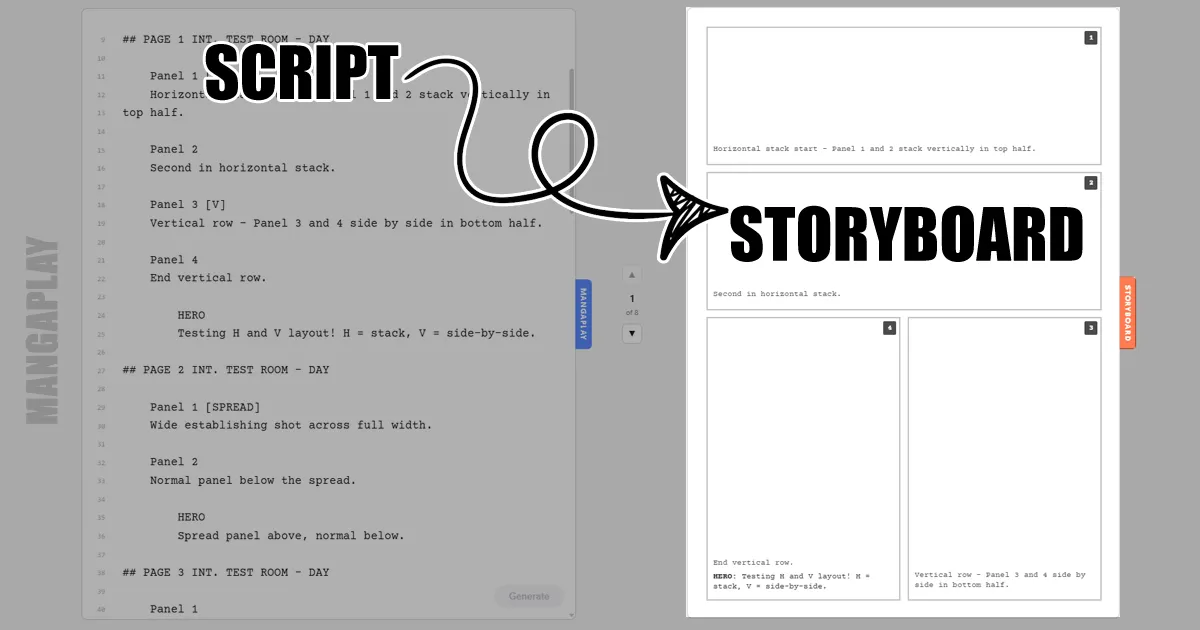
A free comic script template for Google Docs — pages, panels, dialogue, and a ready-to-go Mangaplay/Fountain++ sample. Open, copy, start writing.
Mangaplay Studio vs Superscript — Mangaplay is the spiritual successor to Superscript, the comic script writer that stopped shipping in 2024. Here's how the active replacement compares to the frozen open-source build.